
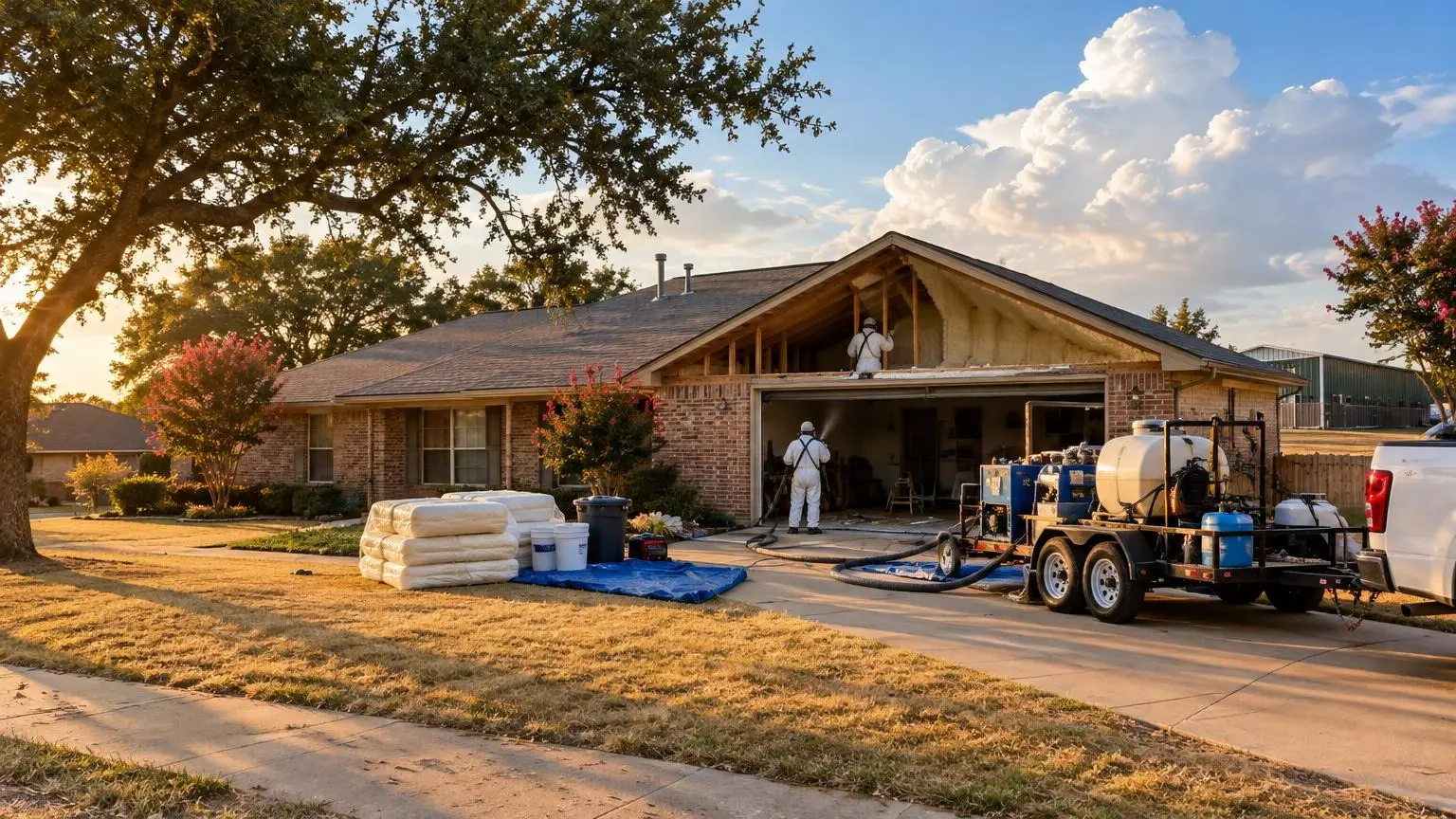
Homes, shops and flat roofs across Arlington and the Mid-Cities
Spray Foam Insulation in Arlington, TX
Cut the attic heat and air leaks that a North Texas summer exposes, with foam where it pays, blown-in where it does not, and every price in writing.
- Free on-site estimates
- Written quote with foam type, thickness and R-value for each area
- Attic, ducts and roof deck checked before anything is sprayed
Insulation for a City That Hits 113 Degrees
Spray foam insulation in Arlington is mostly about keeping summer heat out of the house and keeping cooled air in. Wikipedia lists the city's record high at 113F, set in 1936, and the National Weather Service office in Fort Worth puts the average first 100-degree day at Dallas/Fort Worth on July 1 and the average last one on August 27, with a record 71 such days in 2011. A house that leaks air through its attic or bakes under a thin layer of insulation pays for it every afternoon. We seal those leaks and insulate attics, walls, garages and metal buildings with open-cell or closed-cell spray foam, or with blown-in insulation where that is the better value.
What the code asks for in Arlington
Tarrant County falls in IECC climate zone 3A, and Texas adopted the energy chapter of the 2015 International Residential Code as its statewide standard for single-family homes, effective September 1, 2016, according to the State Energy Conservation Office. The Insulation Institute's summary of that code lists R-38 for ceilings in zone 3 and R-20, or R-13 cavity plus R-5 continuous, for wood-frame walls. For existing homes, ENERGY STAR recommends more: R-49 in a zone 3 attic with no insulation, and R-38 added where 3 to 4 inches already sit on the attic floor. Cities can adopt newer codes than the state minimum, so we check what your city enforces when a permit is involved.
Where Arlington houses lose their cool
Arlington grew from 7,692 residents in 1950 to 90,229 in 1970 and 261,721 in 1990, and the 2020 census counted 151,697 housing units. That means a wide range of houses: post-war ranches with shallow attics, 1970s and 1980s brick homes whose blown-in insulation has settled, and newer two-story homes with bonus rooms over the garage. The leaks show up in the same places. Air escapes around recessed lights, bath fans, plumbing stacks, the attic hatch and the top plates of interior walls. Kneewalls and sloped ceilings in second-floor rooms are often thinly covered. Rooms over a garage lose cooled air through the floor. Where ducts and the air handler sit in the attic, they work inside the hottest space on the property.
Closed cell vs open cell for a hot climate
Open-cell foam is soft and light, rated around R-3.5 to R-3.7 per inch in HomeGuide's guide. It expands to fill odd cavities and stops air movement, and it is the usual choice when an attic is turned into a sealed, semi-conditioned space by spraying the underside of the roof deck. Closed-cell foam is dense and rigid, around R-5 to R-7 per inch (HomeGuide), and it resists water. It suits metal buildings, rim areas, exterior walls that need the most R-value per inch and spray foam roofing. Neither is right for every surface. On a wide attic floor with good access, sealing the leaks and blowing cellulose or fiberglass to depth often costs less and works well. We explain the options and price them side by side when more than one fits.
Shops, metal buildings and flat roofs
Southern Tarrant County has plenty of detached shops, steel buildings and commercial roofs. Uninsulated steel turns into an oven in July and can drip condensation when humid air meets a cooled panel. Closed-cell foam on the panels insulates and seals in one pass. On low-slope roofs, spray foam roofing adds insulation on top of the deck and is finished with a protective coating; HomeAdvisor notes a topcoat refresh every 10 to 15 years. The City of Arlington lists re-roofing among the jobs that need a permit, so roof work is planned with that in mind.
Questions to ask insulation contractors
When you compare spray foam insulation contractors or insulation companies in Arlington, ask what gets sealed before anything is insulated, which foam goes where and why, the thickness and R-value written on the quote, how the attic will be ventilated or sealed, and how long you need to be out after spraying. HomeGuide advises staying out for at least 24 hours. Ask how old insulation that is wet, soiled or crushed will be handled. If an answer is vague, ask again. Our quotes put those answers in writing.
Spray foam insulation cost
HomeGuide's 2026 guide puts installed spray foam at $1.50 to $5.00 per square foot: open-cell at $1.50 to $3.50 and closed-cell at $3.00 to $5.00. Fixr lists $3.15 to $7.50 per square foot for existing walls and $2.75 to $6.50 in new construction. A full house runs $8,000 to $20,000 by HomeGuide's figures, and small jobs often run into a minimum of $1,000 to $2,000 or more. Thickness, foam type, access and prep set the final number. We visit, measure and give you a written estimate, and that estimate is the price.
Utility programs
If Oncor delivers your electricity, its Home Energy Efficiency Program pays incentives to approved service providers for attic, wall and floor insulation and weather-stripping. Its page says 2026 funding has been fully used and to check back in January 2027. Ask about it before you schedule, since program rules and funding change each year.
Why Homeowners Call Spray Foam Insulation Arlington
We look before we price
Attic depth, duct layout, venting, roof deck and walls are checked in person before a quote is written.
Foam only where it earns its cost
If blown-in insulation does the job in part of the house for less, the quote shows it.
Line-by-line quotes
Each area lists the material, thickness, target R-value and price.
Heat-aware scheduling
Attic and roof work is timed around the hottest part of a North Texas day where possible.
Common Questions
What are the building code requirements for insulation in Texas?
The state standard for single-family homes is the energy chapter of the 2015 International Residential Code, effective September 1, 2016. In climate zone 3, which covers Tarrant County, that means R-38 in ceilings and R-20 (or R-13 plus R-5 continuous) in wood-frame walls. Some cities enforce newer editions, so check with your building office.
How much does 2 inches of spray foam cost?
At HomeGuide's R-5 to R-7 per inch, two inches of closed-cell foam lands around R-10 to R-14. HomeGuide lists closed-cell at $3.00 to $5.00 per square foot installed and open-cell at $1.50 to $3.50, with thickness a big driver. We measure the area and price the thickness the space needs in writing.
Why do some people call spray foam a red flag?
Most complaints trace back to installation: wrong mix, wrong thickness, foam over leaks or wet framing, or a sealed attic left without a plan for humidity. Some buyers and inspectors also find it harder to see the roof deck under foam. Careful prep, the right foam for each surface and a written record of what was installed answer most of those concerns.
Should I spray the roof deck or insulate the attic floor?
Spraying the underside of the roof deck brings the attic, and any ducts in it, inside the insulated shell. Insulating the floor keeps the attic hot and vented but costs less. If your ducts and air handler are in the attic, deck foam often makes more sense; if not, a sealed and well-insulated floor may be enough.
Is spray foam or blown-in cheaper?
Blown-in is usually cheaper per square foot. HomeGuide lists blown-in at $1.00 to $2.80 per square foot against $1.50 to $5.00 for spray foam. Foam seals air in the same step, which is why many homes get both: foam to seal, loose fill for depth.
How long do I need to stay out after spray foam?
HomeGuide advises allowing at least 24 hours before re-entering. We give you the time for the product used and ventilate the space before you return.
Our Services
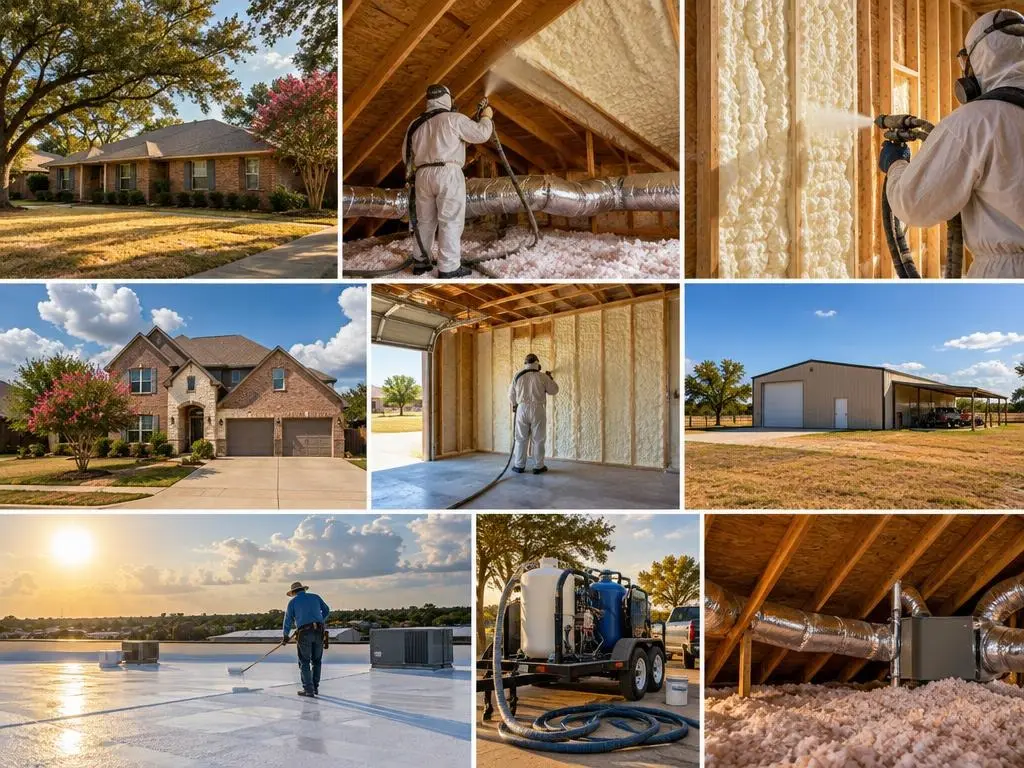
Six services, each sized to the building and the Texas heat.
Spray Foam Insulation
Open-cell and closed-cell foam for attics, walls, garages and bonus rooms.
Learn more →Attic Spray Foam & Air Sealing
Seal the attic floor or the roof deck, and stop hot air from reaching the rooms below.
Learn more →Blown-In Insulation
Cellulose or fiberglass blown to depth over a sealed attic floor, or dense-packed into closed walls.
Learn more →Metal Building & Shop Insulation
Closed-cell foam for steel buildings, shops, barns and garages that bake in summer and drip in winter.
Learn more →Spray Foam Roofing
Seamless closed-cell foam and coating over low-slope commercial and residential roofs.
Learn more →Insulation Removal & Replacement
Out with matted, wet or contaminated insulation, then a clean attic sealed and insulated again.
Learn more →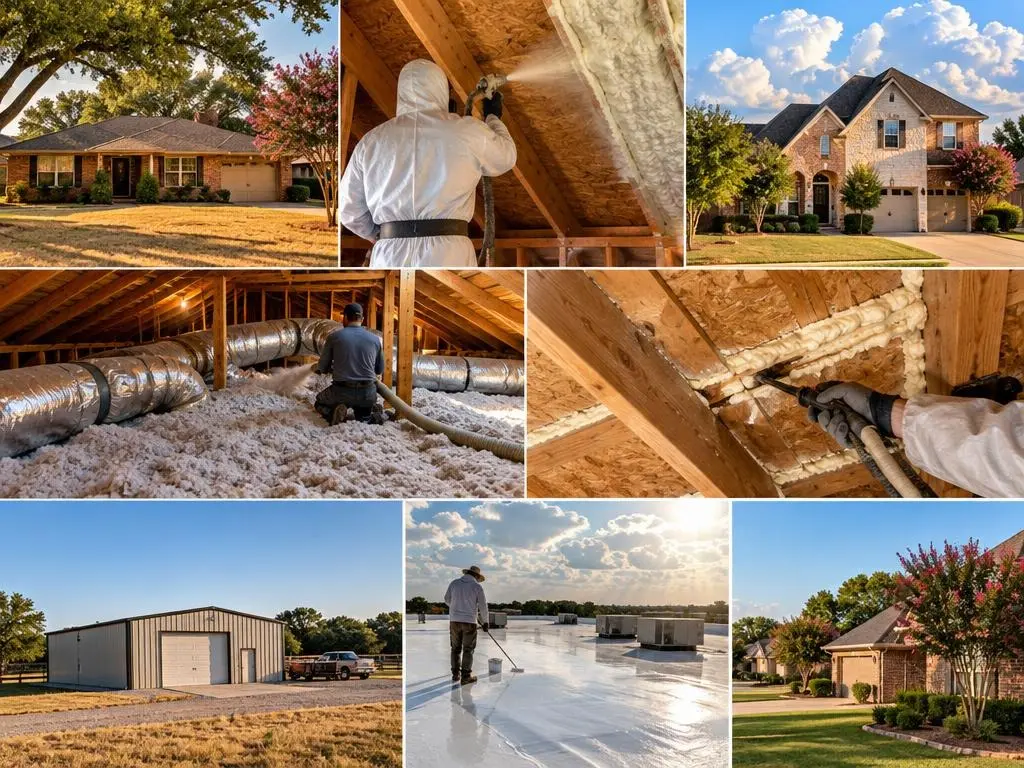
Where We Work
We work in Arlington and the cities that ring it: Pantego and Dalworthington Gardens in the middle of town, Grand Prairie and Irving to the east, Mansfield, Kennedale and Burleson to the south, Euless, Bedford, Hurst and Grapevine to the north, Cedar Hill and Duncanville toward Joe Pool Lake, and Fort Worth and Forest Hill to the west. The houses range from post-war ranches to new subdivisions, and several cities require contractors to register before working, so each town page covers what matters there.
- Spray Foam Insulation in Arlington, TX
- Spray Foam Insulation in Pantego, TX
- Spray Foam Insulation in Dalworthington Gardens, TX
- Spray Foam Insulation in Grand Prairie, TX
- Spray Foam Insulation in Mansfield, TX
- Spray Foam Insulation in Kennedale, TX
- Spray Foam Insulation in Fort Worth, TX
- Spray Foam Insulation in Forest Hill, TX
- Spray Foam Insulation in Euless, TX
- Spray Foam Insulation in Bedford, TX
- Spray Foam Insulation in Hurst, TX
- Spray Foam Insulation in Grapevine, TX
- Spray Foam Insulation in Irving, TX
- Spray Foam Insulation in Cedar Hill, TX
- Spray Foam Insulation in Duncanville, TX
- Spray Foam Insulation in Burleson, TX
Get a Spray Foam Insulation Estimate
Free on-site estimates in Arlington and the Mid-Cities.